Gendered Discourses in Grade 3 English eBooks on a Digital Library Platform

Anna Wing Bo TSO

Asian Journal of English Language Teaching ›› 2024, Vol. 33 ›› Issue (1) : 37-52.

PDF(434 KB)
PDF(434 KB)
Asian Journal of English Language Teaching ›› 2024, Vol. 33 ›› Issue (1) : 37-52.
Research Articles

Gendered Discourses in Grade 3 English eBooks on a Digital Library Platform
  • Anna Wing Bo TSO
Author information +
History +

Abstract

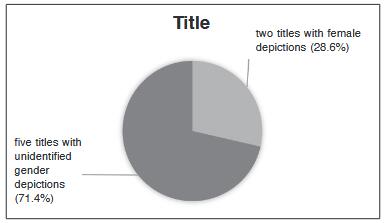
Social justice and gender equality have long been promoted in schools and educa- tion sectors in Hong Kong. However, it remains unclear whether these efforts have led to meaningful changes in children's literature popular among Hong Kong readers. In particular, the extent to which recent children's books have moved away from male-dominated narratives and improved female representation warrants further examination. To increase gender awareness in young readers, parents, teachers, and librarians in the local community and beyond, this paper examines the gender representation in seven Grade 3 English e-chapbooks catego- rized under Reading Recovery (RR) level 22 (for readers aged eight to nine) in Highlights Library, one of the leading digital reading platforms in the world. In terms of the male-to-female ratio in the book titles, book cover illustrations, and central characters of eBooks at RR level 22, the study shows that female charac- ters outnumber male characters in most e-chapbooks catalogued in the digital library. Female characters are no longer underrepresented. In terms of gender discourses, Fairclough's critical discourse analysis (CDA) is used to observe the gender power relations in the narratives of the seven Grade 3 e-chapbooks. All seven e-chapbooks at RR level 22 exhibit different levels of influence from feminism

Cite this article

Download Citations
Anna Wing Bo TSO. Gendered Discourses in Grade 3 English eBooks on a Digital Library Platform[J]. Asian Journal of English Language Teaching. 2024, 33(1): 37-52

References

Aboff, M. (2018). Beach Blues. Highlights Library.
Anderson D. A., Hamilton M. C., Gilkison G. M., & Palmer S. K. (2023). Gender socialization, family leadership, and the invisible father in children's literature.Journal of Family Issues, 44(5), 1343-1357.
Bari, E. (2018). All Aboard. Highlights Library.
Bartles, V. (2018). Tanya's Teddy Bears. Highlights Library.
Brugeilles C., Cromer I., & Cromer S. (2002). Male and female characters in illustrated children's books: How children's literature contributes to the construction of gender.Population [English ed.], 57(2), 292.
Casey K., Novick K., & Lourenco S. F. (2021). Sixty years of gender representation in children's books: Conditions associated with overrepresentation of male versus female protagonists.PLoS one, 16(12), 1-19.
Fairclough, N. (2015). Language and power. Routledge.
Furlong, M. E. (2018). Good Friends. Highlights Library.
Gazda, A. (2015). Once upon a time: Exposing sexism in children's literature [Unpublished master's thesis]. Sate University of New York.
Gonzalez M.,& Gonzalez, M. (2019). They, she, he easy as ABC. Reflection Press.
Gooden, A. M., & Gooden, M. A. (2001). Gender representation in notable children's picture books: 1995-1999.Sex Roles, 45, 89-101.
Hanna, M. L. (2018). The Birthday Box. Highlights Library.
Heikkilä M., Isaksson A., & Stranne F. (2020). Differentiations in visibility— male advantages and female disadvantages in gender-segregated programmes.Frontiers in Sociology, 5, 1-9.
Helenthal, J. (2018). Miss Benson's Class. Highlights Library.
Kovatch, S. (2018). What Am I? Highlights Library.
Leung, E., & Adams-Whittaker, J. (2022). Content analysis of LGBTQ picture books for elementary education through an intersectional lens. InFrontiers in Education, 6(769769).
Lippmann, W. (2023). Public opinion: Stereotypes,Questions de communication 44, 287-300.
Liu, F. (2020). Female objects and feminist consciousness for the purpose to awake readers' awareness: A comparative analysis between Angela Carter'sThe Bloody Chamber and Anne Sexton's Transformations. Emerging Science Journal, 4(1), 25-36.
Lowther, T. (2014, March 8). Children's books still promote gender stereotypes.TheNewRepublic.https://newrepublic.com/article/116943/childrens-books-still-promote-gender-stereotype
Maryna, M. (2024, March 12-15). Beyond pronouns: Rethinking gender representation in linguistic structures [Conference presentation]. The 10th international scientific and practical conference, Stockholm, Sweden.
Montague,R.A.(2021).Queerly radical professional engagement: Reflections on fifty years of book awards. The International Journal of Information, Diversity, & Inclusion (IJIDI),5(5).
Rogers, R., & Villarreal, D. (2022). Critical discourse studies and the scholarship of children's literature. In K. Coats, D. Stevenson, & V. Yenika-Agbaw (Eds.), A Companion to Children's Literature (pp. 314-329). John Wiley & Sons Ltd.
Sharma, N. (2020). Deconstructing the male gaze: The shifting representation of female identity in literature from classical texts to contemporary feminist reinterpretations.International Journal of English and Studies, 2(2), 19-30.
Shu, H. (1998). Sex role socialization in Chinese and American children's books: A comparative study. UMI A Bell and Howell Company.
Tsao, Y. L. (2020). Gender issues in young children's literature.Reading improvement, 45(3), 108-114.
Tso, A. W. B. (2014) Masculine hegemony and resistance in Chinese language.Writing from Below, 2(1), 1-15.
Wilson, B. (2020). Mutilation, metamorphosis, transition, transcendence: Revisiting genderism and transgenderism in the little mermaid through gake no ue no ponyo.Asian children's literature and film in a global age: Local, National, and Transnational Trajectories, 117-137.
Zipes, J. (Ed.) (2014). Don't bet on the prince: Contemporary feminist fairy tales in North America and England. Routledge.
PDF(434 KB)

Accesses

Citation

Detail

Sections
Recommended

/