PDF(629 KB)

The Effects of L1 Use in Pre-task Planning on L2 Speech Fluency
Liping Chen, Weijia Hou
Asian Journal of English Language Teaching ›› 2026, Vol. 35 ›› Issue (3) : 57-75.
PDF(629 KB)
PDF(629 KB)
The Effects of L1 Use in Pre-task Planning on L2 Speech Fluency
Weijia Hou
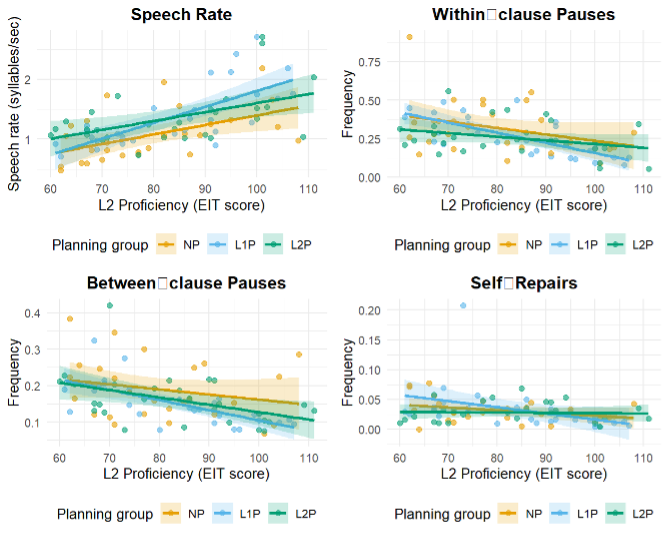
Pre-task planning is one of the widely used approaches to improve second language (L2) fluency in task-based language teaching (Ellis et al., 2020). However, the effect of the language used in pre-task planning on L2 speech fluency remains underexplored. The current study employed a between-participants design to compare the effects of planning languages at three levels: L1 planning, L2 planning, and no planning (a control group), across a narrative task on four measures of L2 speech fluency among 84 Chinese EFL learners. The study also investigated the moderating role of L2 proficiency. Results revealed that L1 planning significantly improved speech rate and marginally reduced between-clause pauses, while L2 planning showed weaker, marginally significant effects. Neither language of planning condition significantly affected within-clause pausing or repair fluency. In addition, within-group correlation analyses revealed that higher L2 proficiency in the L1 planning group was strongly correlated with all fluency measures. Pedagogical implications are discussed in terms of how to optimize L2 speech fluency in different planning languages across different L2 proficiency levels.
Language of pre-tasking planning / L2 speech fluency / first language planning / L2 proficiency
Aubrey, S., & Philpott, A. (2022). Use of the L1 and L2 in strategic planning and rehearsal for task performances in an online classroom. Language Teaching Research, 29(4), 1139-1164. Advance online publication. https://doi.org/10.1177/13621688221077421
Aubrey, S., Lambert, C., & Leeming, P. (2022). The impact of first as opposed to second language pre-task planning on the content of problem-solving task performance. Language Teaching Research, 26(5), 867-892. https://doi.org/10.1177/1362168820917844
Boersma, P., & Weenink, D. (2023). Praat: Doing phonetics by computer (Version 6.4.25) [Computer software]. https://www.praat.org
Bosker, H. R., Pinget, A.-F., Quené, H., Sanders, T., & de Jong, N. H. (2013). What makes speech sound fluent? The contributions of pauses, speed and repairs. Language Testing, 30(2), 159-175. https://doi.org/10.1177/0265532212455394
Bui, G. (2024). There is More to the Task: A Response to Ellis (2024). International Journal of TESOL Studies, 6(4), 14-19[1] . https://doi.org/10.58304/ijts.20240402
Chen, L., Suzuki, Y., & Lambert, C. (2025). L1 and L2 use in pre-task planning and task repetition: The role of proficiency. Applied Linguistics, amaf059. https://doi.org/10.1093/applin/amaf059
de Bot, K. (1992). A bilingual production model: Levelt’s ‘speaking’ model adapted. Applied Linguistics, 13(1), 1-24. https://doi.org/10.1093/applin/13.1.1
de Jong, N. H. (2016). Predicting pauses in L1 and L2 speech: the effects of utterance boundaries and word frequency. International Review of Applied Linguistics in Language Teaching, 54(2), 113-132. https://doi.org/10.1515/iral-2016-9993
de Jong, N. H., & Bosker, H. R. (2013). Choosing a threshold for silent pauses to measure second language fluency. The 6th Workshop on Disfluency in Spontaneous Speech, Sweden. http://disfluency.org/proceedings-of-diss/
East, M., & Wang, D. (2024). Advancing the communicative language teaching agenda: What place for translanguaging in task-based language teaching? The Language Learning Journal, 53(6), 702-714. https://doi.org/10.1080/09571736.2024.2380278
Ellis, R. (2005). Planning and task-based research: Theory and research. In R. Ellis (Ed.), Planning and task-performance in a second language (pp. 3-34). John Benjamins.
Ellis, R. (2009). The differential effects of three types of task planning on the fluency, complexity, and accuracy in L2 oral production. Applied Linguistics, 30(4), 474-509. https://doi.org/10.1093/applin/amp042
Ellis, R. (2024). Task-based and task-supported language teaching. International Journal of TESOL Studies, 6(4), 1-13. https://doi.org/10.58304/ijts.20240401
Ellis, R., Skehan, P., Li, S., Shintani, N., & Lambert, C. (2020). Task-based language teaching: Theory and practice. Cambridge University Press.
Foster, P., & Skehan, P. (1996). The influence of planning and task type on second language performance. Studies in Second Language Acquisition, 18(3), 299-323. https://doi.org/10.1017/S0272263100015047
Foster, P., & Skehan, P. (1999). The influence of source of planning and focus of planning on task-based performance. Language Teaching Research, 3(3), 215-247. https://doi.org/10.1177/136216889900300303
Götz, S. (2013). Fluency in native and nonnative English speech. John Benjamins.
Johnson, M. D., & Tabari, M. A. (2022). Task planning and oral L2 production: A research synthesis and meta-analysis. Applied Linguistics, 43(6), 1143-1164. https://doi.org/10.1093/applin/amac026
Kahng, J. (2018). The effect of pause location on perceived fluency. Applied Psycholinguistics, 39(3), 569-591. https://doi.org/10.1017/S0142716417000534
Khatib, M., & Farahanynia, M. (2020). Planning conditions (strategic planning, task repetition, and joint planning), cognitive task complexity, and task type: Effects on L2 oral performance. System, 93, Article 102297. https://doi.org/10.1016/j.system.2020.102297
Khoram, A. (2026). A comparative analysis of pre-task planning conditions and their effects on intermediate EFL learners’ oral performance. Asian Journal of English Language Teaching, 35(1), 62-82. https://doi.org/10.65961/AJELT-26-1-004
Kormos, J. (1999). Monitoring and self-repair in L2. Language Learning, 49(2), 303-342. https://doi.org/10.1111/0023-8333.00090
Kormos, J. (2006). Speech production and second language acquisition. Lawrence Erlbaum.
Lambert, C. (2023). Integrating systematic practice into task-based language teaching. In Y. Suzuki (Ed.), Practice and automatization in second language research: Perspectives from skill acquisition theory and cognitive psychology (pp. 144-159). Routledge.
Lambert, C., Aubrey, S., & Bui, G. (2023). The role of the learner in TBLT research. In C. Lambert, S. Aubrey, & G. Bui (Eds.), The role of the learner in task-based language teaching: Theory and research (pp. 1-15). Routledge.
Lambert, C., Aubrey, S., & Leeming, P. (2021). Task preparation and second language speech production. TESOL Quarterly, 55(2), 331-365. https://doi.org/10.1002/tesq.598
Lambert, C., Kormos, J., & Minn, D. (2017). Task repetition and second language speech processing. Studies in Second Language Acquisition, 39(1), 167-196. https://doi.org/10.1017/S0272263116000085
Levelt, W. J. M. (1989). Speaking: From intention to articulation. MIT Press.
Levelt, W. J. M. (1999). Producing spoken language: A blueprint of the speaker. In C. Brown & P. Hagoort (Eds.), Neurocognition of language (pp. 83-122). Oxford University Press.
Littlewood, W. (2014). Communication-oriented language teaching: Where are we now? Where do we go from here? Language Teaching, 47(3), 349-362. https://doi.org/10.1017/S0261444812000134
Luo, X., & Sun, P. P. (2025). Greater complexity and higher efficiency: Effects of translanguaging during collaborative pre-task planning on EFL learners’ speaking performance. Language Teaching Research. Advance online publication. https://doi.org/10.1177/13621688241307029
Pica, T., Kanagy, R., & Falodun, J. (1993). Choosing and using communication tasks for second language instruction. In G. Crookes & S. Gass (Eds.), Tasks and language learning. Integrating theory and practice (pp. 9-34). Multilingual Matters.
Plonsky, L., & Oswald, F. L. (2014). How big is “big”? Interpreting effect sizes in L2 research. Language Learning, 64(4), 878-912. https://doi.org/10.1111/lang.12079
Richardson, J. T. (2011). Eta squared and partial eta squared as measures of effect size in educational research. Educational Research Review, 6(2), 135-147. https://doi.org/10.1016/j.edurev.2010.12.001
Sato, R. (2026). Task-based language teaching under scrutiny: Rethinking TBLT in EFL and a revised PPP proposal. Asian Journal of English Language Teaching, 35(1), 111-123. https://doi.org/10.65961/AJELT-26-1-006
Scott, V. M., & de la Fuente, M. J. (2008). What’s the problem? L2 learners’ use of the L1 during consciousness-raising, form-focused tasks. The Modern Language Journal, 92(1), 100-113. https://doi.org/10.1111/j.1540-4781.2008.00689.x
Segalowitz, N. (2010). Cognitive bases of second language fluency. Routledge.
Skehan, P. (1996). A framework for the implementation of task-based learning. Applied Linguistics, 17, 38–62. https://doi.org/10.1093/applin/17.1.38
Skehan, P. (1998). A cognitive approach to language learning. Oxford University Press.
Skehan, P. (2003). Task-based instruction. Language Teaching, 36(1), 1-14. https://doi.org/10.1017/S026144480200188X
Skehan, P. (2014). The context for researching a processing perspective on task performance. In P. Skehan (Ed.), Processing perspectives on task performance (pp. 1-26). John Benjamins. https://doi.org/10.1075/tblt.5.01ske
Skehan, P., Foster, P., & Shum, S. (2012). The task is not enough: Processing approaches to task-based performance. Language Teaching Research, 16(2), 170-187. https://doi.org/10.1177/1362168811428414
Skehan, P., Foster, P., & Shum, S. (2016). Ladders and snakes in second language fluency. International Review of Applied Linguistics in Language Teaching, 54(2), 97-111. https://doi.org/10.1515/iral-2016-9992
Suzuki, S., & Kormos, J. (2023). The multidimensionality of second language oral fluency: Interfacing cognitive fluency and utterance fluency. Studies in Second Language Acquisition, 45(1), 38-64. https://doi.org/10.1017/S0272263121000899
Tavakoli, P., & Skehan, P. (2005). Strategic planning, task structure, and performance testing. In R. Ellis (Ed.), Planning and task performance in a second language (pp. 239-273). John Benjamins. https://doi.org/10.1075/lllt.11.15tav
Trondheim, L. (2007). Mr. I. Nantler, Beall and Minoustchine.
Wickham, H. (2009). ggplot2: Elegant graphics for data analysis. Springer.
Wu, S.-L., Tio, Y. P., & Ortega, L. (2022). Elicited imitation as a measure of L2 proficiency: New insights from a comparison of two L2 English parallel forms. Studies in Second Language Acquisition, 44(1), 271-300. https://doi.org/10.1017/S0272263121000103
Yuan, F., & Ellis, R. (2003). The effects of pre-task planning and on-line planning on fluency, complexity, and accuracy in L2 monologic oral production. Applied Linguistics, 24(1), 1-27. https://doi.org/10.1093/applin/24.1.1



/
| 〈 |
|
〉 |